

What God Says About Your Shame
Most of us understand that sin leads to guilt — that uneasy, convicting awareness that we’ve done something wrong. But there’s a deeper, darker layer beneath guilt that often goes unaddressed: shame. And if you’ve ever wondered why you keep falling into the same patterns of sin, shame may be the hidden engine driving the cycle.
Here’s the critical difference: guilt is about what you’ve done. Shame is about who you are. Guilt says, “I did something bad.” Shame says, “I am something bad.” While guilt can lead to healthy repentance, shame — if left unchecked — actually fuels the very behavior you’re trying to escape.
The Shame Cycle
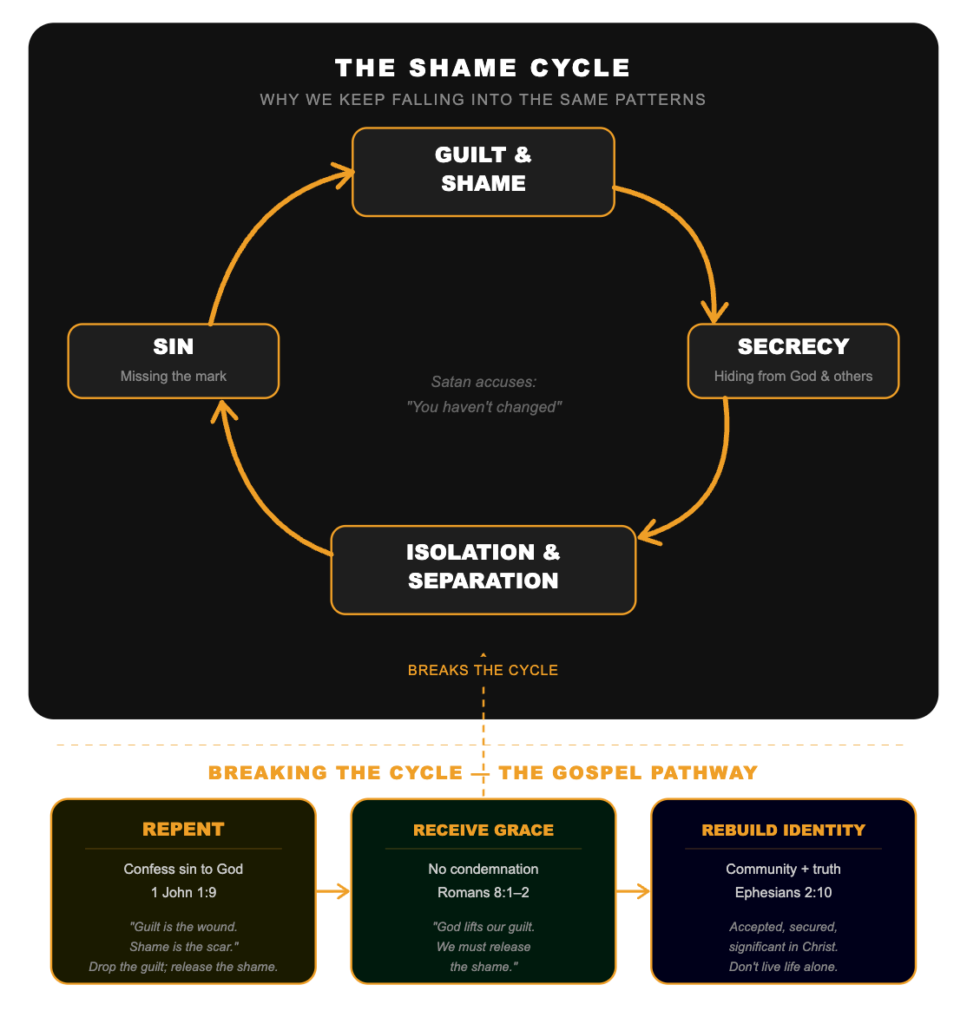
When we sin, the natural response is guilt. But if we don’t receive God’s grace and forgiveness, guilt curdles into shame. Shame triggers feelings of worthlessness, isolation, and fear of exposure. To cope with those feelings, we often numb, hide, or escape — and those avoidance behaviors frequently lead right back into sin. The cycle repeats, each loop tightening our belief that we are beyond help or change.
Satan — whose very name means accuser — exploits this perfectly. He uses shame to convince you that you haven’t changed, can’t change, and don’t deserve to. Shame isolates you from God and from community. And a person cut off from God and community is a person in a spiritually dangerous place.
This is an ancient problem. When Adam and Eve sinned, their first response wasn’t just guilt — it was shame. “I was afraid because I was naked; so I hid” (Genesis 3:10). Shame poisons our thinking, paralyzes our growth, and isolates us from the very relationships we need to heal.
What God Says About Your Shame
The prophet Isaiah records one of the most powerful promises in all of Scripture: “Instead of your shame you will receive a double portion, and instead of disgrace you will rejoice in your inheritance” (Isaiah 61:7). Shame is not God’s portion for you. His language is abundance, favor, and everlasting joy — not condemnation.
God has already dealt with your guilt through Jesus. Romans 8:1 is clear: “There is now no condemnation for those who are in Christ Jesus.” But while God lifts your guilt, you must release your shame. That release comes by confronting shame with the truth of the gospel — that you are accepted, secured, and significant in Christ.
Breaking Free
Freedom from the shame cycle begins with repentance — honest confession that opens the door to God’s forgiveness (1 John 1:9). It continues as you receive His grace rather than push it away. It deepens as you remember your true identity: you are God’s handiwork, created for good works (Ephesians 2:10). And it grows stronger in community — because shame thrives in secrecy but withers in the light of authentic relationship.
Satan says, “Shame on you.” Jesus says, “Shame off of you.”
You can’t alter your past. But you can leave your past at the altar.
Application Questions
1. Guilt vs. Shame:
Can you identify a specific sin or failure in your past where you’ve moved from guilt (what you did) into shame (redefining who you are)? How has that shame affected your behavior since?
2. Community And Accountability:
Shame grows in isolation. Is there someone in your life — a friend, a pastor, a small group — with whom you can be honest about your struggles? What is one concrete step you can take this week to move toward authentic community? In what areas of your life are you currently “hiding” — from God, from others, or from yourself? What would it look like to step out of hiding and into the light of grace?
3. The Accuser’s Lies:
What are the specific shame-based messages that replay in your mind (e.g., “I always mess up,” “I’m not like other Christians”)? How do these contrast with what Scripture says about your identity in Christ?
4. Receiving Grace:
Romans 8:1 says there is no condemnation for those in Christ. Do you actually believe this applies to you personally? What makes it difficult to receive — not just intellectually accept — God’s forgiveness?
5.Community And Accountability:
Community and accountability: Shame grows in isolation. Is there someone in your life — a friend, a pastor, a small group — with whom you can be honest about your struggles? What is one concrete step you can take this week to move toward authentic community?