
NEW WRITING: SAVED FOR A GREATER PURPOSE

The Story Of Jephthah Reminds Us That God Wastes Nothing.
NEW WRITING: SAVED FOR A GREATER PURPOSE Read More »
The Story Of Jephthah Reminds Us That God Wastes Nothing.
NEW WRITING: SAVED FOR A GREATER PURPOSE Read More »
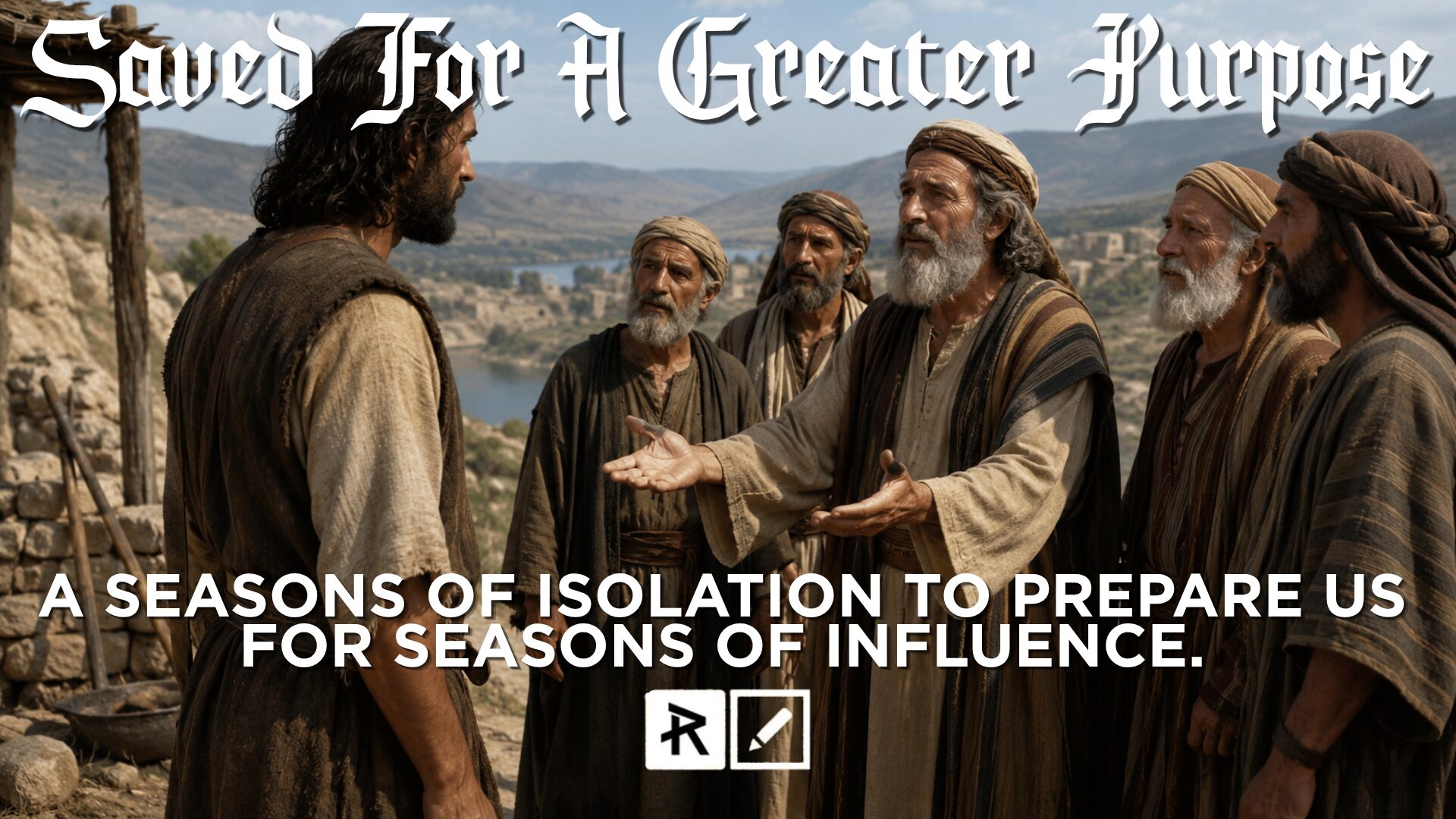
The Story Of Jephthah Reminds Us That God Wastes Nothing.
There are seasons when it feels like you’ve been pushed to the margins of your own story. Relationships become strained. Family grows distant. Friends no longer understand your convictions. The people who once knew you best no longer recognize the person God is shaping you to become.
If you’ve ever felt overlooked, abandoned, or forgotten, the story of Jephthah reminds us that God wastes nothing.
A Mighty Warrior in Exile
In Judges 11, we meet Jephthah, a mighty warrior whose life began with rejection. Because he was the son of a prostitute, his brothers drove him away, denying him his inheritance and forcing him into exile. He settled in the land of Tob, where other outcasts gathered around him. To many, it appeared his story had already been written and rejected by his family. Cast aside by society. Living far from home. Yet God was not finished with him.
When Israel found itself under attack from the Ammonites, the very elders who had allowed Jephthah to be cast out came searching for him, stating, “Come and be our leader, that we may fight against the Ammonites. “Jephthah’s response is one that many of us can relate to: “Did you not hate me and drive me out of my father’s house? Why have you come to me now when you are in distress?” (Judges 11:7)
The people who once rejected him now recognized that God had been preparing the very man they had overlooked.
When Your Past Precedes You
Like Jephthah, many of us carry a reputation that precedes us. Our friends and coworkers often know the version of ourselves that we choose to present. But no one knows our history quite like our family. They remember the hot-headed version of us—the one who made poor decisions. The person before Christ began His work in our hearts.
When we surrender our lives to Jesus, we begin putting off the old self and walking in obedience. We stop compromising. Our priorities change. We pursue holiness instead of popularity. Ironically, those changes don’t always bring acceptance. Sometimes they bring distance. Sometimes they make us “unintentionally uninvited” because following Christ means being pushed away, because we’re no longer willing to compromise our convictions.
The Land of Tob
Being driven into Tob may have looked like defeat, but Tob was known as a good land, a refuge for outsiders. In many ways, the church is our modern-day Tob. It is a refuge where broken people are restored, disciples are formed, and God prepares ordinary people for extraordinary purposes. Whether you’ve followed Christ for forty years or you have taken your first step of faith, you’ve entered a place where broken people are being restored together.
The world may see believers as weak, outdated, or even foolish. Yet here, among God’s people, He is shaping men into something far greater. The church is where disciples are sharpened. It is where wounded hearts are healed. Where warriors are prepared, but God isn’t simply raising warriors. He is raising priests.
Your Exile Has a Purpose
God often uses seasons of isolation to prepare us for seasons of influence. The place that feels like exile may be your training ground. Every hardship. Every disappointment. Every lonely season, every difficult conversation and sacrifice made to follow Christ. God is using it to prepare you for a greater assignment.
Jesus heals our deepest wounds not simply so we can move on, but so we can become instruments of healing for others. He restores us so we can restore. He comforts us so we can comfort. He saves us so we can faithfully serve.
More Than a Warrior
A warrior fights battles. A priest stands in the gap. God’s desire is not merely to make you spiritually strong but spiritually available. There will come a day when your family and friends experience crisis. When sickness strikes, when a marriage begins to crumble, when anxiety overwhelms someone you love, when death visits your home.
In those moments, they won’t simply need someone who can solve problems. They will need someone who knows how to pray. Someone who can lead with wisdom instead of panic, who can point hurting people to Christ, someone willing to intercede on behalf of others.
Like Jephthah, there may come a day when the very people who once rejected you remember the transformation God has accomplished in your life. Not because you became successful or because you have proved them wrong. But because Christ made you into someone they could turn to when hope seemed lost.
The Return of the Priest
Jephthah didn’t simply return home as a warrior. He returned as a leader. Likewise, God is preparing His people to return to their families, workplaces, neighborhoods, and communities as spiritual leaders who reflect Christ. Your calling extends beyond surviving your season of exile. You are being equipped to bring peace where there is conflict, hope where there is despair, prayer where there is fear, and the presence of Christ into places that desperately need Him. The rejection you experienced is not the end of your story. It may simply be the beginning of God’s preparation.
So, let me leave you with this question: Have you allowed Jesus to make you mission-ready?
The world doesn’t simply need more strong men. It needs faithful priests, men who will stand before God on behalf of their families, lead with humility, love sacrificially, and point others to Jesus Christ. Perhaps the season you’re in right now isn’t punishment, or God hiding you.
Perhaps it’s God preparing you.
One day He may call you to return not simply as someone who survived rejection, but as a priest who brings the hope of Christ to those who once overlooked you.
Application Questions
1. Where in your life do you feel like Jephthah in the land of Tob — pushed to the margins, overlooked, or exiled from the place you once belonged? How might God be using that season to prepare you rather than punish you?
2. Has following Christ ever created distance between you and people who used to know you well? How did you respond, and how do you view that distance now — as loss, or as evidence of real change?
3. A warrior fights battles; a priest stands in the gap for others. Who in your life needs you to show up not with answers or strength, but with prayer and presence? What would it look like to step into that role for them this week?
SAVED FOR A GREATER PURPOSE Read More »

Take A Step Into What God Is Calling You To Do
NEW WRITING: VALOR IS CALLING Read More »

Take A Step Into What God Is Calling You To Do
“The Lord is with you, O mighty man of valor.” — Judges 6:12
In the book of Judges, Israel repeatedly turned away from God. At one point, He allowed the Midianites to oppress them for seven years. They stole Israel’s crops and livestock, leaving the land desolate. When the suffering became unbearable, Israel cried out to God for help. God then called on Gideon to liberate them.
When we first meet Gideon, he isn’t standing on a battlefield. He’s hiding in a winepress, secretly threshing wheat. In that moment, God came to him with surprising words:
“The Lord is with you, O mighty man of valor.”
Valor means having great courage in the face of danger, fear, or difficulty.
The interesting part is that Gideon didn’t feel courageous. He immediately listed all the reasons God had the “wrong” person — his family was the weakest in Manasseh, and he was the youngest in his father’s house. In his mind, there was nothing remarkable about him. Fear has a way of convincing us that we’re unqualified, too weak, or too far behind for God to use us. Gideon knew that feeling well.
But God wasn’t looking at Gideon’s current condition. He was looking at who Gideon would become. God answered every excuse with one simple promise:
“I will be with you.”
Even then, Gideon struggled to believe. He asked for signs, not once but multiple times. God patiently confirmed His promise until Gideon’s trust began to grow.
Then came the real test. God reduced Gideon’s army from 32,000 men to just 300. Humanly speaking, the odds were impossible. Israel faced approximately 135,000 Midianite soldiers — one Israelite for every 450 enemies.
Why would God do that? Because He wanted His people to know that victory comes from Him, not from human strength. The generation that had inherited the Promised Land had forgotten the God who delivered Israel from Egypt, parted the Red Sea, and provided manna in the wilderness. God wasn’t just rescuing His people — He was restoring their trust in Him.
Years later, God did something similar. When Samuel searched for Israel’s next king, God passed over Jesse’s older, more seasoned sons and chose the youngest — a shepherd boy named David. Like Gideon, David wasn’t the obvious choice. But he trusted God, defeated a giant, won battle after battle, and became one of Israel’s greatest kings.
As you live through today’s challenges, you may feel like Gideon. Maybe you don’t feel qualified, or your past discourages you. Fear may keep whispering that you’re not good enough. But have valor — the Lord is with you.
What is God calling you to? Maybe it’s to fight for your family, or to forgive someone. Maybe it’s to break free from an addiction, pursue a career that honors Him, step into serving, or surrender your life fully to Jesus. Whatever it is, your confidence doesn’t have to come from your ability. It comes from God.
Today, take a step into what God is calling you to do — even if it feels small.
Remember: “The Lord is with you, O mighty man of valor.”
Application Questions
1. Guilt vs. Shame:
Like Gideon in the winepress, where in your life right now are you hiding, playing small, or telling yourself you’re not the right person for what God has put in front of you?
2. Community And Accountability:
Gideon’s confidence never came from his ability — it came from God’s presence and promise. What would change in how you approach your current fear or excuse if you truly believed “I will be with you” was enough?
3. The Accuser’s Lies:
What is one specific step — even a small one — you can take this week toward what God is calling you to, whether that’s a hard conversation, a habit to break, or a door to walk through?

What God Says About Your Shame
NEW WRITING: HOW SHAME KEEPS YOU IN SIN Read More »

What God Says About Your Shame
Most of us understand that sin leads to guilt — that uneasy, convicting awareness that we’ve done something wrong. But there’s a deeper, darker layer beneath guilt that often goes unaddressed: shame. And if you’ve ever wondered why you keep falling into the same patterns of sin, shame may be the hidden engine driving the cycle.
Here’s the critical difference: guilt is about what you’ve done. Shame is about who you are. Guilt says, “I did something bad.” Shame says, “I am something bad.” While guilt can lead to healthy repentance, shame — if left unchecked — actually fuels the very behavior you’re trying to escape.
The Shame Cycle
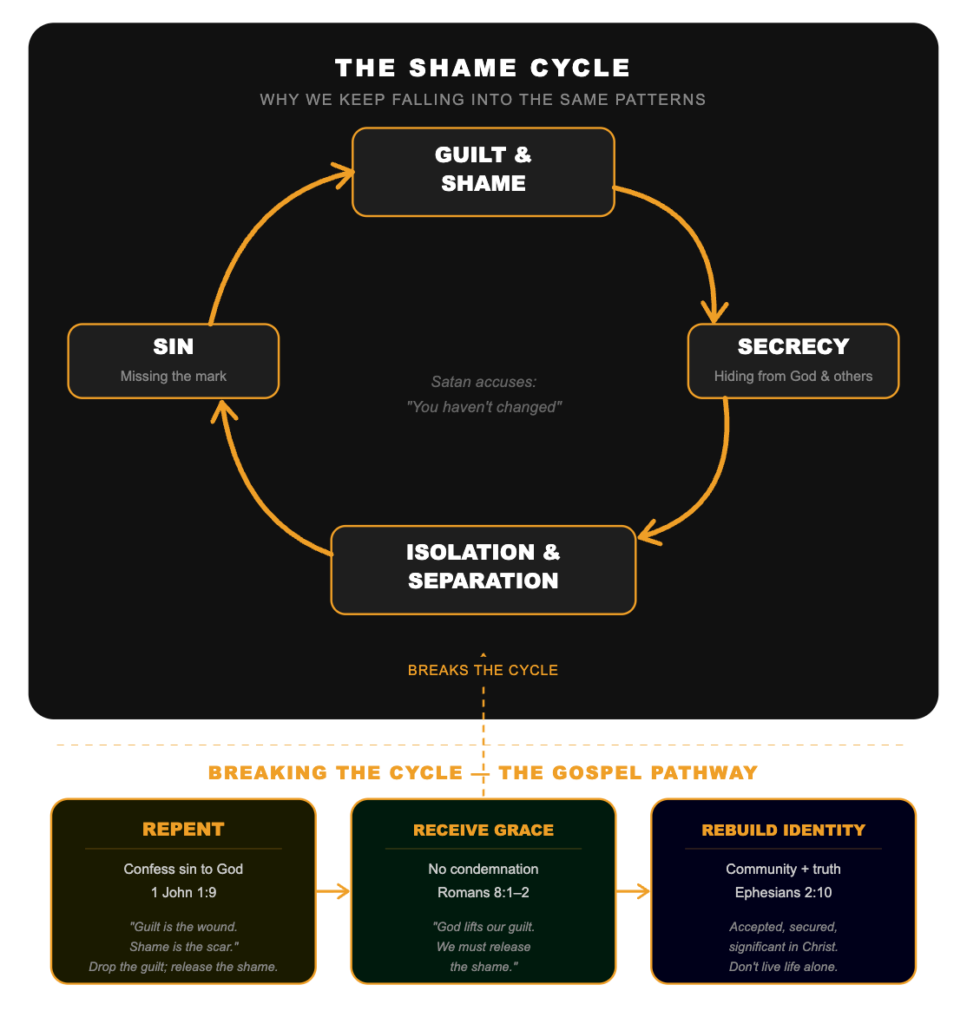
When we sin, the natural response is guilt. But if we don’t receive God’s grace and forgiveness, guilt curdles into shame. Shame triggers feelings of worthlessness, isolation, and fear of exposure. To cope with those feelings, we often numb, hide, or escape — and those avoidance behaviors frequently lead right back into sin. The cycle repeats, each loop tightening our belief that we are beyond help or change.
Satan — whose very name means accuser — exploits this perfectly. He uses shame to convince you that you haven’t changed, can’t change, and don’t deserve to. Shame isolates you from God and from community. And a person cut off from God and community is a person in a spiritually dangerous place.
This is an ancient problem. When Adam and Eve sinned, their first response wasn’t just guilt — it was shame. “I was afraid because I was naked; so I hid” (Genesis 3:10). Shame poisons our thinking, paralyzes our growth, and isolates us from the very relationships we need to heal.
What God Says About Your Shame
The prophet Isaiah records one of the most powerful promises in all of Scripture: “Instead of your shame you will receive a double portion, and instead of disgrace you will rejoice in your inheritance” (Isaiah 61:7). Shame is not God’s portion for you. His language is abundance, favor, and everlasting joy — not condemnation.
God has already dealt with your guilt through Jesus. Romans 8:1 is clear: “There is now no condemnation for those who are in Christ Jesus.” But while God lifts your guilt, you must release your shame. That release comes by confronting shame with the truth of the gospel — that you are accepted, secured, and significant in Christ.
Breaking Free
Freedom from the shame cycle begins with repentance — honest confession that opens the door to God’s forgiveness (1 John 1:9). It continues as you receive His grace rather than push it away. It deepens as you remember your true identity: you are God’s handiwork, created for good works (Ephesians 2:10). And it grows stronger in community — because shame thrives in secrecy but withers in the light of authentic relationship.
Satan says, “Shame on you.” Jesus says, “Shame off of you.”
You can’t alter your past. But you can leave your past at the altar.
Application Questions
1. Guilt vs. Shame:
Can you identify a specific sin or failure in your past where you’ve moved from guilt (what you did) into shame (redefining who you are)? How has that shame affected your behavior since?
2. Community And Accountability:
Shame grows in isolation. Is there someone in your life — a friend, a pastor, a small group — with whom you can be honest about your struggles? What is one concrete step you can take this week to move toward authentic community? In what areas of your life are you currently “hiding” — from God, from others, or from yourself? What would it look like to step out of hiding and into the light of grace?
3. The Accuser’s Lies:
What are the specific shame-based messages that replay in your mind (e.g., “I always mess up,” “I’m not like other Christians”)? How do these contrast with what Scripture says about your identity in Christ?
4. Receiving Grace:
Romans 8:1 says there is no condemnation for those in Christ. Do you actually believe this applies to you personally? What makes it difficult to receive — not just intellectually accept — God’s forgiveness?
5.Community And Accountability:
Community and accountability: Shame grows in isolation. Is there someone in your life — a friend, a pastor, a small group — with whom you can be honest about your struggles? What is one concrete step you can take this week to move toward authentic community?
HOW SHAME KEEPS YOU IN SIN Read More »

The Tragedy of Incomplete Obedience
NEW WRITING: DRIVING OUT COMPROMISE Read More »
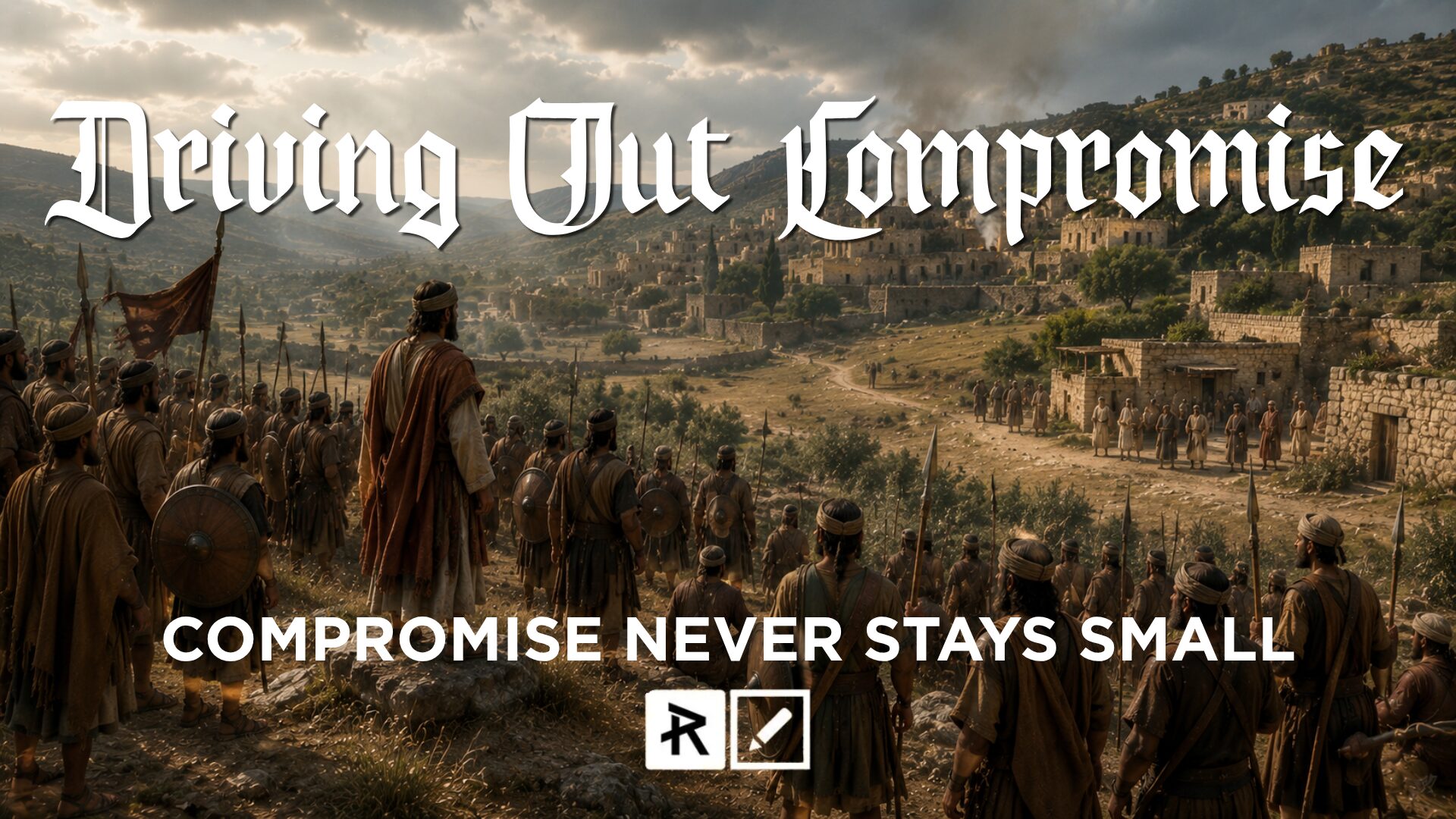
The Tragedy of Incomplete Obedience
“Yet the people of Israel did not drive out…” (Joshua 13:13). That phrase is one of the quiet tragedies of Scripture. God promised victory. God granted the land. Yet Israel allowed their enemies to remain.
Joshua 15:63 says, “But the Jebusites… the people of Judah could not drive out, so the Jebusites dwell with the people of Judah at Jerusalem to this day.” What was meant to be conquered was tolerated. What was tolerated became embedded.
Men do this spiritually. We compartmentalize sin. We assume it can remain contained—private, managed, harmless. But Paul warns, “Do you not know that a little leaven leavens the whole lump?… Cleanse out the old leaven” (1 Corinthians 5:6–7). Compromise never stays small.
The Tragedy of Incomplete Obedience
God commanded Israel: “You must devote them to complete destruction… make no covenant with them” (Deuteronomy 7:2). The Hebrew yarash means to dispossess, to drive out. The land was promised (Joshua 1:3), but promise still required obedience.
Incomplete Obedience Is Still Disobedience
Psalm 106 records the result: “They did not destroy the peoples… but mingled with the nations and learned their practices” (vv. 34–35). Coexistence became corruption. False gods followed. Generational decay followed. Eventually, exile followed.
The Jebusites remained until David conquered Jerusalem (2 Samuel 5:6–10). The Geshurites reappear when David marries Maacah; their son Absalom rebels (2 Samuel 3:3). Compromise breeds consequences. You cannot coexist with the enemy and expect peace.
You Cannot Conquer Alone
Judges 1 tells us tribes attempted conquest but failed. Effort was not enough. As men, our instinct is self-reliance: try harder, discipline more, suppress desire. But sin is not driven out by willpower.
David ultimately finished what Judah could not—he conquered Jerusalem. The king accomplished what the people failed to do. This foreshadows Christ. “For the weapons of our warfare are not of the flesh but have divine power to destroy strongholds” (2 Corinthians 10:4–5, ESV). Jesus, the greater David, storms the strongholds within us. At the cross, He decisively defeated sin and death.
Charles Spurgeon wrote, “The conquest may be delayed by unbelief, but not denied. What God gives, He enables us to take.” Victory begins with surrender.
Full Victory Is Found in Full Surrender
God does not call men to partial obedience. He calls us to total allegiance. Do not leave your Jebusites in the land. By the power of the greater Joshua, the greater Gideon, the greater David—Jesus Christ—we can drive out compromise and walk in lasting victory.
How to Drive Out Compromise
1. Lift Your Eyes to the Lord.
You can not and do not have to do this alone. Psalm 121:1–2 reminds us, “My help comes from the Lord.” Shift your focus from the enemy to your Deliverer.
2. Identify Your Jebusite
Call it what it is. Sexual immorality. Dishonesty. Spiritual apathy. Neglect of leadership at home. Silence in prayer. You cannot conquer what you refuse to name.
3. Tear Down and Rebuild
Gideon destroyed the altar of Baal before he led Israel (Judges 6). Then he built an altar to the Lord. Replace vice with virtue. “Do not be overcome by evil, but overcome evil with good” (Romans 12:21). Where compromise existed, build discipline. Where passivity ruled, establish leadership. Where sin consumed, let righteousness flourish.
DRIVING OUT COMPROMISE Read More »

Three ancient traps the enemy uses to devour that we need to avoid.
NEW WRITING: THREE TRAPS EVERY MAN WILL FACE Read More »

The Three Traps That Take Men Down
“Do not love the world or the things in the world. If anyone loves the world, the love of the Father is not in him. For all that is in the world—the desires of the flesh and the desires of the eyes and pride of life—is not from the Father but is from the world. And the world is passing away along with its desires, but whoever does the will of God abides forever.” — 1 John 2:15-17
Years ago, I heard a preacher say something I’ve never forgotten: “Men of God — don’t touch the gold, the glory, or the girls.”
Three words. Three traps. And over the years, I’ve watched them take out more men than any illness or accident ever could. Not all at once — that’s rarely how it happens. It starts small. A glance that lingers too long. A purchase that becomes a pattern. A desire for recognition that quietly curdles into obsession. And before long, a man is down.
The Bible calls our enemy a roaring lion, actively seeking whom he can devour (1 Peter 5:8). He’s not passive — he’s a predator with a strategy. He doesn’t show up with a pitchfork. He shows up with a secret and an opportunity. And he uses three ancient traps to do it.
Trap 1: The Trap of Pleasure (Lust of the Flesh)
This is the oldest trap in the book, and it works by targeting how you feel. It promises comfort, ease, and gratification — through sex, pornography, substances, or any other counterfeit that delivers a short-term high and a long-term cost.
Samson was the most physically powerful man in human history. He defeated thousands in battle. But what armies couldn’t do, one woman did — because he kept surrendering to the pull of pleasure. He woke up one day not even realizing he’d lost his strength. David was a warrior and a worship leader, but one glance grew into a sin that destroyed lives and families.
That’s how it works. Sin rarely announces itself. It creeps.
The winning strategy? Don’t fight it — flee it. Joseph ran so fast from temptation that Potiphar’s wife was left holding his coat. That’s the model. You may need to end a relationship, delete an app, or install accountability software. The flesh responds to one thing: being told no.
Trap 2: The Trap of Possession (Lust of the Eyes)
“The eyes of man are never satisfied” (Proverbs 27:20). This trap is fueled by comparison — a constant hunger for more, better, newer, bigger.
Social media has handed the enemy a megaphone for this one. Someone else’s vacation, house, or career becomes the measuring stick for your contentment, and discontentment is a short walk from envy and greed.
Judas had a front-row seat to the Son of God and betrayed Him for the price of a slave — thirty pieces of silver. That’s what unchecked desire for money and things can reduce a man to.
The antidote is counterintuitive: give. Generosity is the cure for greed. Get a budget. Fast from media. The man who holds everything loosely is the man who can’t be bought.
Trap 3: The Trap of Pride (Pride of Life)
This is the most dangerous of the three — because it doesn’t feel like a trap. It feels like ambition.
C.S. Lewis called pride “the complete anti-God state of mind.” It was the first sin — not in the garden, but in heaven, when Lucifer decided he deserved the worship rather than the Creator. Pride wants to build your persona (who people think you are) while quietly neglecting your character (who you actually are).
The fix starts with two questions: Who is my source? And Is this stewardship or ownership? When you recognize that your gifts, your platform, and your influence belong to God — pride loses its grip. Celebrate others. Practice secret disciplines. Stay accountable to a brother who’s allowed to ask you hard questions.
You Are Purposed for More
These three traps — Pleasure, Possession, and Pride — are ancient, but they are not invincible. Name the one you’re fighting. Take one concrete action this week. And confess it to someone, because James 5:16 reminds us that we were never meant to carry this alone.
The enemy is real. But so is the God who is for you.
Application Questions:
THE THREE TRAPS EVERY MAN WILL FACE Read More »