
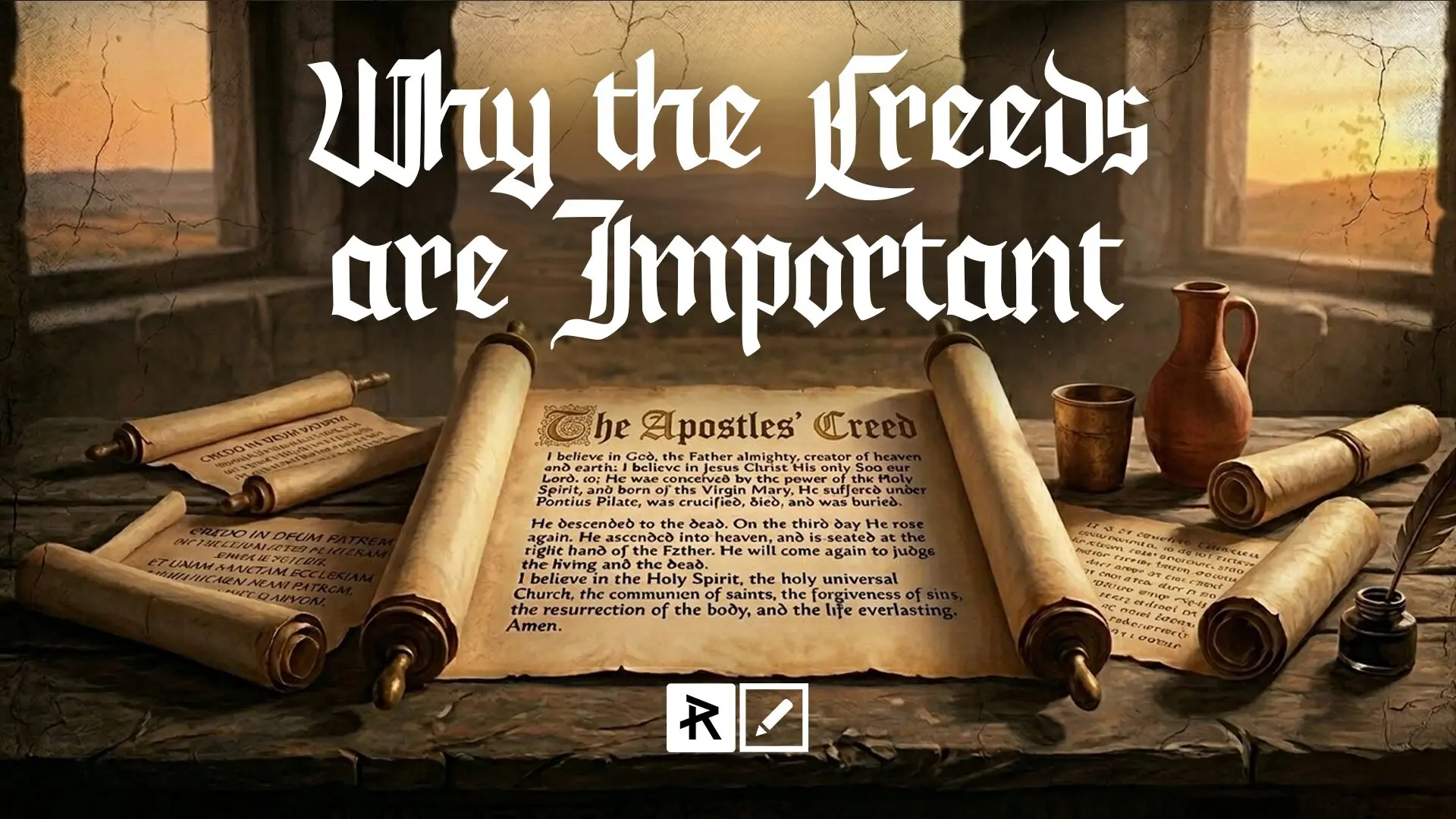
Why the Creeds Are Important
Do you believe in God, the Father Almighty?” “I believe,” said the man as he stood in the cool waters of the Tiber River. On this day in mid-2nd century Rome, the man professed his faith in the living Christ before being lowered into the waters of baptism. The confession he recited was the Old Roman Creed, a direct predecessor of what would become the Apostles’ Creed. The Apostles’ Creed, and those that came before it, served as a clear declaration of allegiance to Jesus in a world full of competing loyalties. Later, in the fourth century, the Church would formalize the Nicene Creed in response to the major heretical teachings it faced. Though the creeds are not Scripture themselves, they summarize and affirm the core truths of our faith as presented to us in Scripture. This is why I love the creeds. It is easy to view them as mere ancient tradition, or at worst, as dead religion. But I believe the creeds have much to offer us as we seek to live lives built on the truth of God’s Word. There are three ways I believe the creeds help believers today.
First, they connect us to centuries of unchanged truth upon which the Church has trusted and lived. When we recite the creeds, we are not simply reciting a list of facts — we are reciting the truths of the Christian faith that have united believers across time, across borders, and across denominational lines. We remind ourselves of where we have come from. Church history did not begin the day we chose to follow Christ or the year our local church was founded. Faithful men and women have recited and lived out these truths for hundreds of years. We are reminded of the truth that Jesus shared with His disciples: “On this rock I will build my church, and the gates of hell shall not prevail against it.” (Matthew 16:18)
Second, the creeds serve as a structured framework of the truths that make us Christian. Since the beginning of the Church, Christians have lived as a people set apart — in this world, but not of it. The creeds remind us of what we have chosen to believe in contrast to what the world would say. We serve a triune God, who is one yet three, a truth that sets Christianity apart from every other religion. We serve a God who took on humanity and willingly laid down His own life on a criminal’s cross — something no other supposed god or deity has ever done. We declare that our salvation comes not from our own deeds, but from the finished work of our Savior. Every line of the creeds reminds us of how wonderful and awesome our God is, and how unique and beautiful the Church is.
Finally, they reflected an oath of allegiance to Jesus in a world full of competing loyalties. For early Christians, this meant resisting the command to worship Caesar as lord, the pull of pagan idols and practices, and the lure of mystery cults promising secret knowledge. Today, it is the temptation to go with the flow of culture or to keep our faith private so as not to offend. The creeds remind us to whom our allegiance belongs. We are children of God, citizens of His Kingdom — and whether reciting them alone or together with the communion of believers, we declare again that our hearts, our strength, and our souls belong to the One who loved us and gave His life for us.
So what do we do in light of this? Read the creeds. Recite them. Memorize them. Give glory to the Lord that through His Son, Jesus, and His Word, He has revealed Himself to us. The creeds are a wonderful reminder of that revelation and a means by which all followers of Christ are grounded in the truth and unity of our faith. May we never treat them as relics of the past, but as living declarations that shape how we believe, how we worship, and how we face the world each day.
Read, Recite, and Reflect on the Apostles Creed
I believe in God, the Father almighty, creator of heaven and earth;
I believe in Jesus Christ, His only Son, our Lord; He was conceived by the power of the Holy Spirit, and born of the Virgin Mary, He suffered under Pontius Pilate, was crucified, died, and was buried. He descended to the dead. On the third day, He rose again. He ascended into heaven and is seated at the right hand of the Father. He will come again to judge the living and the dead.
I believe in the Holy Spirit, the Holy Universal Church, the communion of saints, the forgiveness of sins, the resurrection of the body, and the life everlasting. Amen.